The Queensland Government made significant legislative changes in recent years to help tackle the problem of child drowning’s. Statistics show that a child under the age of 5 has a higher likelihood of drowning in a residential pool than in any other water course. On the 10th of November 2014, the Pool Safety Council was disbanded and all pool safety licensing, compliance and disciplinary functions were migrated to the Queensland Building and Construction Commission (QBCC).
Under new guidelines, you must have a Pool Safety Inspection carried out by a licensed Pool Safety Inspector prior to selling or renting your property. If you are not selling or renting your property, you must have a pool barrier that complies with the pool safety standard from the 1st of December, 2015.
We can help you ensure you receive a Cairns pool safety certificate and that your pool meets legal requirements, walking you through the current legislation and providing professional advice on pool fencing and barriers. As licensed specialists dedicated to offering the highest standard of professionalism and expertise, we provide efficient pool safety inspections with friendly and helpful service.
Cairns Building Inspections offer Pool Safety & Fence Inspections for…
- Pre-Sale if you’re selling your home
- Pre-Purchase with your Building & Pest Inspection to make things easy
- Post-Settlement if you’ve just bought a home
- Landlords
- Any homeowner anytime, if you’ve decided to stay put & want peace of mind
PRE-INSPECTION CHECKLIST
- Install a CPR sign. This must be a minimum of 30cm X 30cm and be put up somewhere that is clearly visible from anywhere within the pool area (we usually suggest installing the CPR sign near the shallow end of the pool because this is the most likely place a victim will be taken to in the event of an emergency).
- Check that gates providing access to the pool area are “self-closing” and lock by themselves from any position along their arc of operation.
- The height of your pool fence must be at least 1200 mm from finished ground level.
- The distance from the bottom of your fence to permanent stable ground must be no greater than 100 mm.
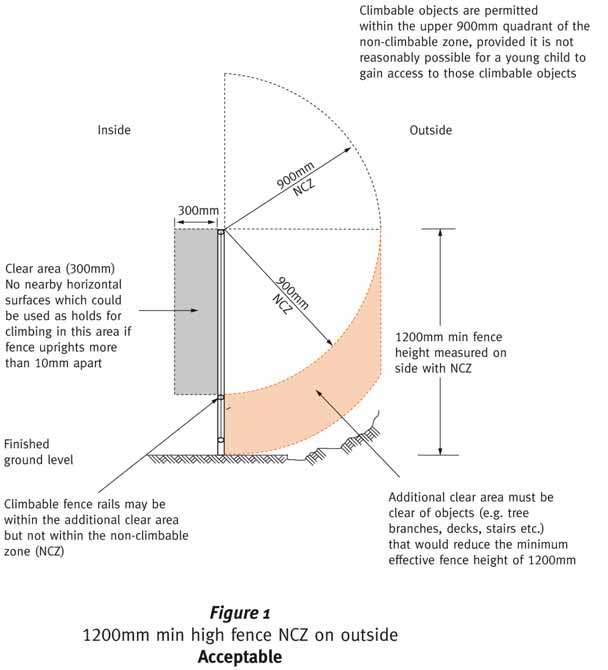
- Remove climbable objects within the Non-Climbable Zone. This is an imaginary zone which extends 900mm away from and 1200mm down from the top of your pool fence.
- All branches or plants that a child could use to climb over the pool safety barrier must be removed or trimmed back.
- Security screens must be installed on windows/louvers that provide direct access to the pool area or V-Hinges screwed into the window tracks so that windows/louvers cannot open more than 100mm.
Inspection Process
The process for gaining pool certification consists of an inspection where your Pool Safety Inspector will check the pool area for any issues or areas of non-compliance. If there are no issues you will receive your Pool Safety Certificate within 48 hours. If there are changes necessary for compliance, your Pool Safety Inspector can provide you with a Pool Safety Report Form 26 which outlines exactly what the issues are with your pool area and offers solutions for how these issues can be resolved. Alternatively we can fix the issues found for a mutually agreed fee. Once these issues have been addressed, your Pool Inspector is required to undertake a second pool inspection and (assuming the necessary changes have been made) grant you your Pool Safety Certificate. Please click on “Pool Checklist” above so that you have the best chance of passing your initial inspection.
CHECKLIST
All gates open away from the pool.
□ Bottom of latch release on gate is at least 1500mm from finished ground level.
□ When the gate is closed, it must lock securely and cannot be pulled open from fully latched position.
□ Pool gate/s must selfclose from every position along their arc of operation including from just one centimetre away from the locking mechanism.
□ The top of each gate hinge must be 900mm apart, or have a 60° angled caps fitted on top of the hinge.
□ There are no gaps under the fence or gate to permanent, stable ground of more than 100mm.
□ There are no climbable objects closer than 300mm on the inside of a fence where the gap to object through fence is greater than 10mm.
□ All components of gate, fence posts are tight and secure.
□ There are no gaps in or under the fence, or barrier to the pool, of more than 100mm.
□ No gaps of more than 100mm open up when two vertical fence rails are squeezed together.
□ There are no windows or doors that open more than 100mm and provide direct access to the pool.
□ The fence is no less than 1200mm to stable ground at all points. (See Diagram 1)
□ There is nothing measuring greater than 10mm in diameter and could support 25kg within 900mm on the outside of the pool fence. (See Figure 1)
□ There are no objects such as steps, pot, plants, rocks, decks etc. at ground level and within 1200mm of the highest point of the fence. (See Figure 1 – orange shaded section)
□ There are no pot plants or any other climbable objects against the fence on the inside or outside of the pool fence.
□ There are no horizontal footholds on the outside of the fence greater than 10mm in width.
□ Horizontal rails on boundary / pool fences are no closer than 900mm. (See Figure 1)
□ There is a current CPR sign measuring at least 30cm x 30cm clearly visible from all points of the pool area.
Diagram 1 – Non-Climbable Zones for a typical 1200mm fence
Please understand that every pool and the structures around it is different. The above checklist is intended to help you pass your initial inspection but may not contain all points that apply to your specific pool. More detailed information can be found using the following link: http://www.hpw.qld.gov.au/SiteCollectionDocuments/QDCMP3.4SwimmingPoolBarriers.pdf
A Pool Safety Inspectors first duty is to protect the safety of the public. For this reason it may be necessary to schedule a second inspection if your pool has any non-conformity issues. This second inspection, if necessary, must be completed within 3 months of the initial inspection by the same Pool Safety Inspector who undertook the initial inspection. It will be done at the discounted rate of $80.
Pre-purchase pool inspections – giving property buyers peace of mind.
Are you buying a property without a valid pool safety certificate? A seller can sell a property without valid certification; however, they will have to give you a notice of no pool safety certificate (Form 36) before you make your offer. In this case, it is always recommended to get a pre-purchase pool inspection done to help you establish if any works need to be carried out on the pool barrier to ensure it’s compliance.
The benefits of getting a pre-purchase pool inspection done before buying the property are:
- The pool or spa may not comply with the pool safety laws and can pose a safety risk to your young children. Our clear and easy to understand report will give you the information you need to prevent risk to your family.
- It is the pool owners responsibility to ensure the pool complies with the pool safety standards, but if they issue a Form 36, the chances are the pool doesn’t comply and repairs are needed to get the pool safe. These repairs can amount to thousands of dollars. Knowing these costs ahead of time can save you a lot of money in the long run.
Are You in Port Douglas, Innisfail or the Tablelands and Have a Pool?
Ensure your pool fencing is compliant and obtain a Pool Safety Certification with a licensed inspector. We service the wider region and take the stress out of certifying your pool. We have stayed up to date on all legislative changes and are licensed inspectors, able to provide specialist advice on pool fencing and barriers, as well as issue pool safety certificates in line with legal requirements. Don’t get overwhelmed by the legislation, allow us to provide stress-free inspections no matter what your situation.
For sellers… we recommend a pre-sale Pool Safety Certificate, which you can obtain before you even list and is valid for up to two years. If there is no pool safety certificate obtained, before entering a sale contract or settlement it is the seller’s responsibility to provide an advisory notice to:
- The potential buyer
- Department of Housing and Public Works
- Pool Owner, such as the body corporate for shared pools
For buyers… if you accept a Notice of No Pool Safety Certificate on purchasing a new property you have until 90 days post settlement to make the pool fence compliant and are liable for any costs required to certify your pool (unless otherwise negotiated under your individual contract).
For landlords… you must obtain a pool safety certificate before a lease is signed. This applies for body corporate as well. The existing safety certificate will cover any new leases or renewals within the validity period.
Wherever you are: Cairns, Port Douglas, Innisfail or the Atherton Tablelands – we can help you ensure your pool is safe and compliant!